
The Minimum Payment Mirage: Why It Exists and How a Minor Shift Reclaims Your Wealth
Sep 22, 2026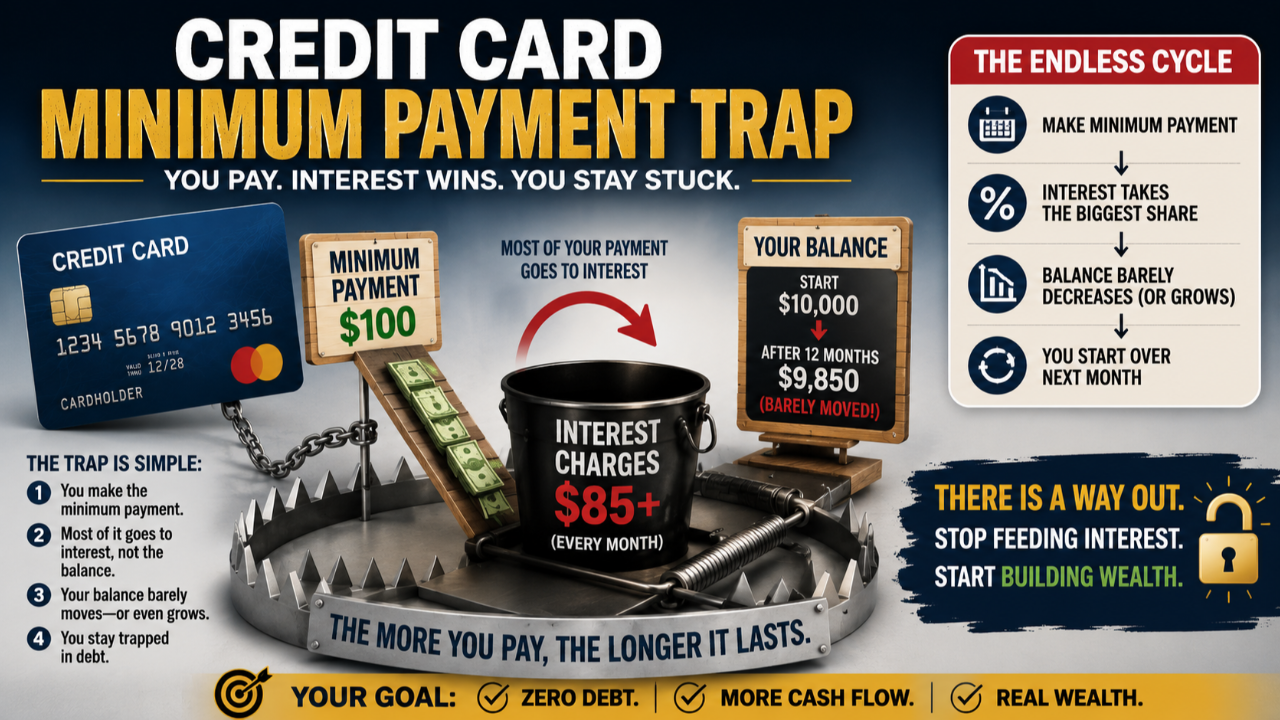
"Debt is like any other trap; it is easy enough to get into, but very hard to get out of."
— Henry Wheeler Shaw
STRATEGIC FINANCIAL MANAGEMENT
An unvarnished look at the mechanics behind credit card minimums—and the exponential power of adding just $50.
By Clifton Vaughn
Higher Ground Financial Coaching
Every month, millions of cardholders open their statements, glance at the "Minimum Payment Due" line, send that exact dollar figure, and breathe a sigh of relief. The obligation is satisfied, the account remains in good standing, and credit scores stay intact.
Yet behind that modest monthly sum lies one of the most engineered consumer mechanisms in modern finance. The minimum monthly payment is not an amortization schedule designed to free you from debt; it is a carefully calibrated balance point designed to keep capital moving while maximizing finance charges over decades.
The Two Sides of the Ledger: Why Minimum Payments Exist
To master your personal balance sheet, you have to understand the operational incentives driving both sides of the transaction.
The Card Issuer's Perspective
- Profit Maximization: Credit card issuers earn their highest margins on revolving debt. Stretching principal payoff across 15 to 20 years maximizes total compound interest accrued.
- Solvency Confirmation: Regular monthly payments confirm the borrower is alive, active, and managing payments without entering charge-off territory.
- Predictable Cash Inflows: Minimums recover accrued fees and monthly interest plus a fractional sliver of principal (~1%), maintaining liquidity while retaining high-yielding receivables.
The Cardholder's Perspective
- Legal Safe Harbor: Paying the minimum fulfills the cardholder agreement, preventing late fees ($30–$40+) and punitive default interest rates (often 29.99%+).
- Credit File Protection: The account reports as "Paid as Agreed" / "Current" to major credit reporting agencies, preventing severe 30-day delinquency marks.
- Short-Term Cash Flexibility: It acts as an emergency relief valve during unexpected cashflow crunches, allowing users to buy time without immediate legal default.
The Mechanics: How Issuers Set the Floor
Most credit card issuers determine the minimum monthly payment using one of two primary methods (whichever results in the higher amount, subject to a fixed floor like $25–$35):
Interest + Percentage Formula (Most Common): Accrued monthly interest + fees + 1% of the total balance.
Flat Percentage Formula: A flat 2% to 3% of the entire outstanding statement balance.
The Anatomy of the Math: A $5,000 Real-World Case Study
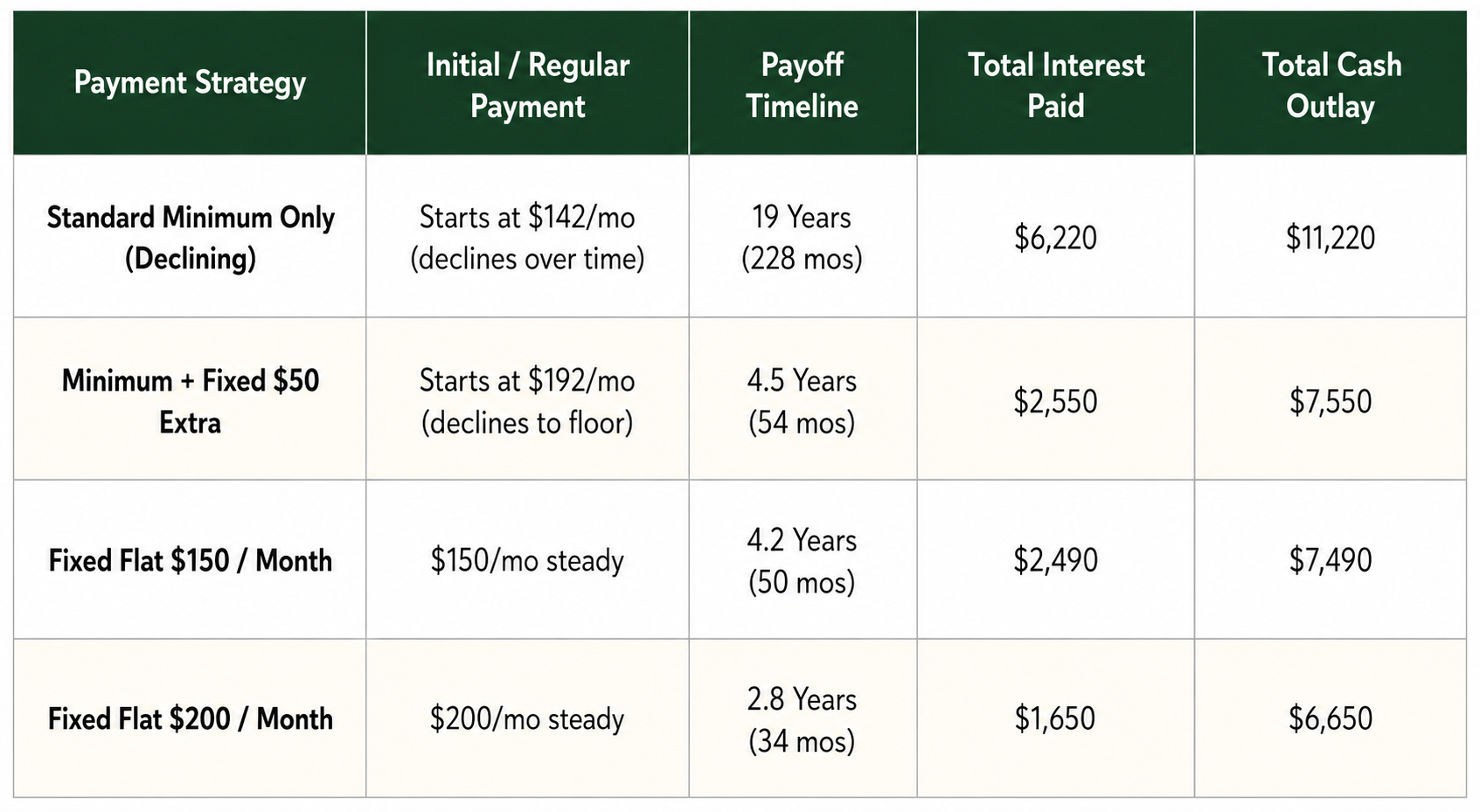
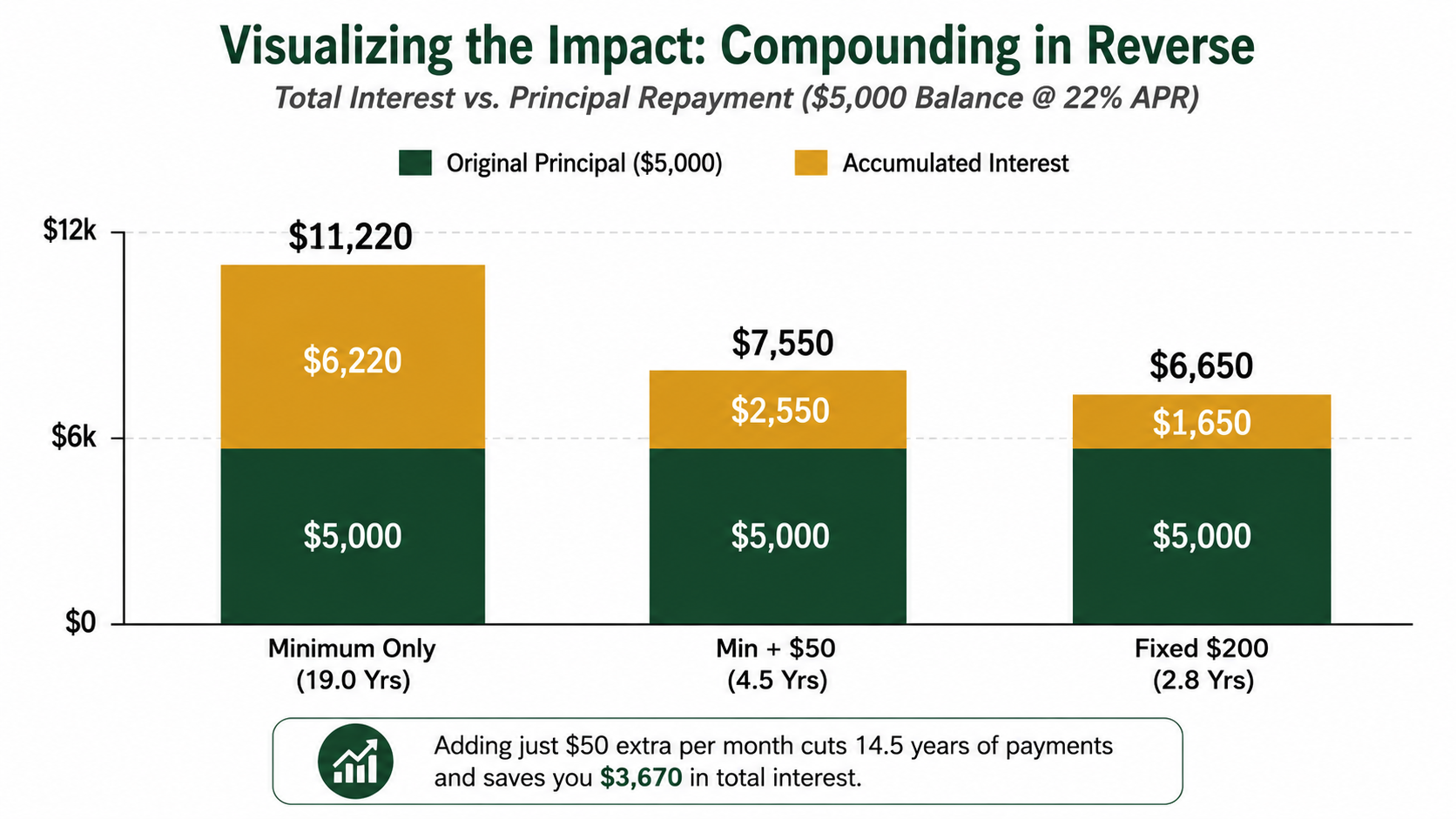
Consider a cardholder carrying a $5,000 balance at a 22.0% APR. Under the standard industry formula (Interest + 1% of principal, or a $35 minimum floor), here is how the numbers unfold:
Month 1 Breakdown: At 22.0% APR, the first month's interest alone is $91.67. A standard minimum payment of ~$141.67 allocates only $50.00 toward the actual $5,000 principal. The remaining 65% is consumed entirely by finance charges.
The Multiplier Effect: Why Extra Payments Work So Fast
The asymmetric impact of an extra $50 lies in how credit card contracts apply funds. By law, any payment exceeding the minimum must be applied directly to the balance bearing the highest interest rate, directly hacking away at the principal.
When you pay only the minimum, you reduce principal by a meager ~$50 on a $5,000 balance. When you pay Minimum + $50, you double your principal amortization on day one. This starves the compound interest engine of fuel, chopping 14.5 years of payments and putting $3,670 in cash back in your control.
Key Actionable Takeaways
- Never treat the minimum as the target: The minimum payment is a lender-protection floor, not a debtor payoff plan.
- Fix your payment amount: Avoid declining monthly payments as your balance drops. Keep paying the original fixed dollar amount to accelerate payoff exponentially.
- Automate the extra layer: Setting up an automatic transfer of an extra $50–$100 each billing cycle prevents wealth leakage and converts high-interest liabilities into debt freedom years ahead of schedule.
Paying more than the minimum is one of the simplest ways to take control of your money. But once high-interest debt is under control, the next question is just as important:
What will you do with the money you no longer have to send to your creditors?
The goal isn't simply to become debt-free. It's to create a financial system where every dollar you free up has a purpose—and eventually works toward building your wealth.
That's the foundation of 5 Ways to Build Wealth Without Earning More: learning how to direct the money you already earn toward the things that matter most.
Ready to stop letting your money work against you?
Learn How to Build Wealth Without Earning More
Want articles like this in your inbox? Subscribe for free wealth-building tips.
Keep Reading
- Maximizing Your Money: Are Credit Card Annual Fees Worth It In 2026?
- Budgeting Is Not a Diet: 5 Steps to a Sustainable Spending Plan
- Build Wealth Without Earning More
- The Myth of "I'll Be Fine When I Earn More"
- Financial Literacy Isn't the Goal. Financial Capability Is.
- The 3 Buckets of Wealth: Why You Must Build Wealth Beyond Your Job and Your Business
Start with our Basecamp Community
We are spreading the good news of financial clarity and freedom
Don't worry, your information will not be shared.
We hate SPAM. We will never sell your information, for any reason.
Author